 Graz
Graz By Zaha Hadid Architects
Explore Deconstructivist in GrazThe Vandelay collection
Deconstructivist architecture dismantles the conventions of form, geometry, and structural logic.
12 buildings in this collection · 7 cities · 5 countries

Look closer
Deconstructivism is visually unmistakable — the deliberate violation of architectural norms is the point.
Titanium, zinc, and other metallic claddings in non-standard configurations. Gehry's Guggenheim Bilbao and Vitra Design Museum use crumpled titanium and stucco panels. Hadid's Fire Station in Weil am Rhein is pure concrete but shaped into razor-sharp planes. Glass is often tilted or fragmented rather than flat.
Colliding volumes, acute angles, and fragmented geometries. Buildings appear to be in mid-explosion or mid-collapse. Libeskind's Jewish Museum in Berlin uses a zigzag plan with slashed voids that cut through the entire structure. Koolhaas's Casa da Música in Porto is a faceted concrete polyhedron that looks carved rather than built.
Non-repetitive, asymmetric facades where each surface plane meets its neighbour at an unexpected angle. Windows are slashes, voids, or irregular openings rather than regular grids. Surfaces may be smooth (Hadid) or crumpled (Gehry), but they are never conventional.
Acute and obtuse angles — no right angles where you expect them
Tilted walls, leaning columns, skewed floor plates
Windows as slashes or voids cut into surfaces
Colliding volumes that appear to intersect or overlap
Absence of visual stability — the building resists resolution
Interior spaces that disorient through unexpected geometries
Deconstructivist buildings are designed to disrupt their context. They reject the idea that a building should defer to its neighbours. The Guggenheim Bilbao transformed an industrial waterfront; Libeskind's Jewish Museum cuts through Berlin's urban fabric. These buildings create new contexts rather than responding to existing ones.
Follow a building’s city guide to explore more examples of this architecture.
Graz By Zaha Hadid Architects
Explore Deconstructivist in Graz Porto
Porto By Rem Koolhaas
Explore Deconstructivist in Porto Steindorf am Ossiacher See
 By Günther Domenig
Explore Deconstructivist in Steindorf am Ossiacher See Berlin
 By Frank Gehry
Explore Deconstructivist in Berlin Bilbao
 By Frank Gehry
Explore Deconstructivist in Bilbao Rome
Rome By Zaha Hadid Architects
Explore Deconstructivist in Rome Weil am Rhein
 By Frank Gehry
Explore Deconstructivist in Weil am Rhein Berlin
 By Zaha Hadid Architects
Explore Deconstructivist in Berlin Berlin
 By Daniel Libeskind
Explore Deconstructivist in Berlin Weil am Rhein
 By Frank Gehry
Explore Deconstructivist in Weil am Rhein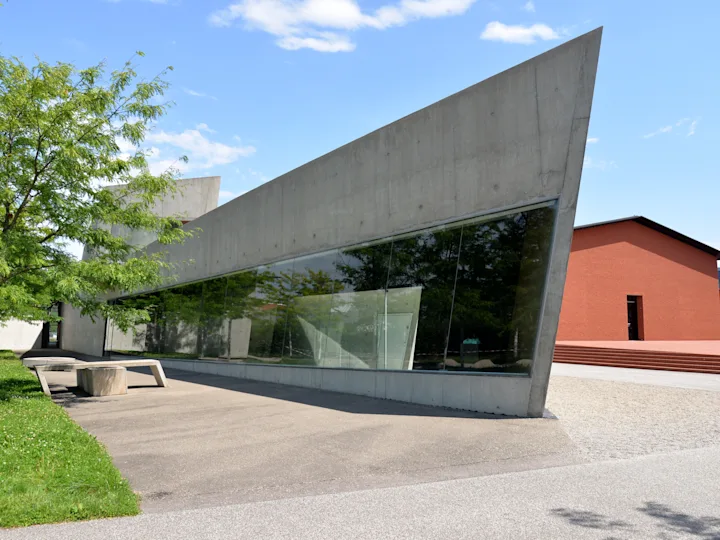 Weil am Rhein
 By Zaha Hadid Architects
Explore Deconstructivist in Weil am Rhein Porto
Porto By Barbosa & Guimarães Arquitectos
Explore Deconstructivist in PortoThe wider context
Deconstructivist architecture dismantles the conventions of form, geometry, and structural logic. Buildings appear fractured, skewed, or colliding — as if architecture itself is being taken apart and reassembled wrong. The catalogue holds 12 Deconstructivist buildings across 7 cities.
The movement crystallised in the late 1980s, driven by a small group of architects — Frank Gehry, Zaha Hadid, Rem Koolhaas, Daniel Libeskind — who rejected both Modernist rationalism and Postmodernist historicism. Key examples can be found in Weil am Rhein (3 buildings) and Berlin (3).
These buildings challenge the assumption that architecture should be stable, predictable, or comfortable. They create spaces of disorientation, surprise, and intellectual provocation — and they house some of the world's most important cultural institutions.
Start with the cities with the most documented examples in this collection. Each count refers to buildings tagged Deconstructivist in Vandelay.
Germany Start with Vitra Design Museum.
Explore Deconstructivist in Weil am RheinGermany Start with DZ Bank Building.
Explore Deconstructivist in BerlinPortugal Start with Casa da Música.
Explore Deconstructivist in PortoCounts show their documented Deconstructivist buildings. The links open each architect’s wider collection.
Take it with you
Find documented buildings on the map, explore their stories and see nearby places with live distances in AR.