
Berlin
79 buildingsModernist · Brutalist
Residential complex at Skalitzer Straße / Admiralstraße / Kottbusser Tor
The Vandelay collection
Start in Berlin, our largest city collection, then follow Bauhaus architecture to Dessau and expressionism to Potsdam. Modernist housing, sculptural churches and experimental civic buildings offer several paths through the guides.
99 buildings14 cities in this collection

Where to begin
The largest city collections are a useful starting point. Follow a guide to explore its buildings and architectural context.
Modernist · Brutalist
Residential complex at Skalitzer Straße / Admiralstraße / Kottbusser Tor

Private House · Neoclassicist
Antivilla

Deconstructivist
Vitra Design Museum
Places to look closer
A selection from our Germany collection. Each card takes you to the corresponding city guide.
 Dessau-Roßlau
 Bauhaus · Modernist
Walter Gropius
Explore Dessau-Roßlau guide Berlin
 High-tech · Futurist
Ralf Schüler, Ursulina Schüler-Witte
Explore Berlin guide Velbert
 Brutalist · Sacred
Gottfried Böhm
Explore Velbert guide Berlin
 Expressionist · Modernist
Hans Scharoun
Explore Berlin guide Bensberg
 Brutalist
Gottfried Böhm
Explore Bensberg guide Potsdam
 Expressionist · Neue Sachlichkeit
Erich Mendelsohn
Explore Potsdam guide Alfeld
 Industrial · Modernist
Walter Gropius, Adolf Meyer
Explore Alfeld guide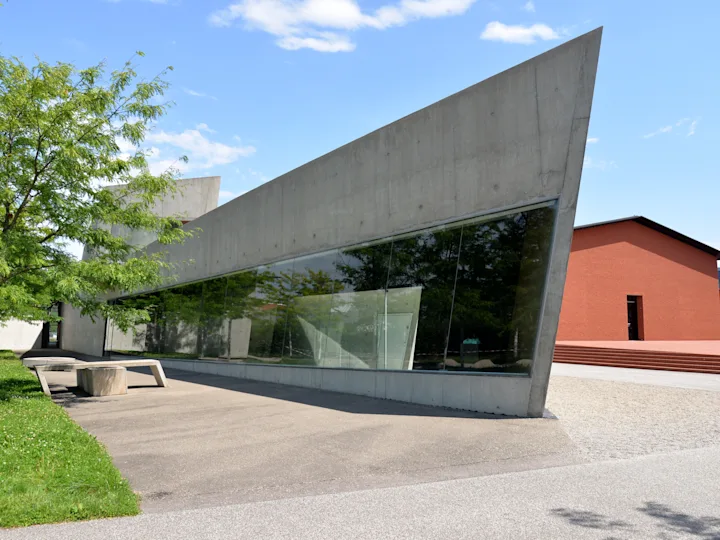 Weil am Rhein
 Deconstructivist
Zaha Hadid Architects
Explore Weil am Rhein guide Berlin
 Deconstructivist
Daniel Libeskind
Explore Berlin guide Berlin
 Modernist
Ludwig Mies van der Rohe
Explore Berlin guide Köln
Köln Brutalist · Sacred
Gottfried Böhm
Explore Köln guide Berlin
 Neues Bauen · Bauhaus · Modernist
Martin Wagner, Bruno Taut
Explore Berlin guideFollow an interest
These styles are the most represented in our Germany collection. Choose a city to see local examples.
Look for Dessau Bauhaus in Dessau-Roßlau and Berlin State Library in Berlin .
Look for Wallfahrt Neviges in Velbert and Bensberg City Hall in Bensberg .
The wider context
Our Germany collection includes 99 notable buildings across 14 cities, spanning 33 architectural styles from early Expressionism to post-reunification Deconstructivism. The densest concentration is in Berlin, with 79 documented buildings, followed by Potsdam and Weil am Rhein. This is the country that gave the world the Bauhaus, shaped the language of Brutalism through Gottfried Böhm's churches, and continues to produce bold contemporary work by practices like Zaha Hadid Architects and Daniel Libeskind.
Use the selected buildings in this collection to compare architectural forms, materials and approaches. Current catalogue counts appear in the style links above.
The most widespread style in the catalogue. Look for flat roofs, ribbon windows, white or light-coloured rendered facades, and an absence of applied ornament. Structural clarity is the point — load-bearing walls give way to open floor plans. Key examples range from Ludwig Mies van der Rohe's minimal pavilions to post-war civic buildings across Berlin and beyond.
Look for exposed concrete, substantial sculptural volumes, deep-set openings and the imprint of formwork. Compare Gottfried Böhm’s pilgrimage church in Velbert and Church of the Resurrection of Christ in Köln with his civic work at Bensberg City Hall. Berlin’s housing and public buildings offer further examples within the collection.
Dramatic, sculptural forms that prioritise emotion over function. Look for unusual curves, faceted surfaces, pointed or crystalline shapes, and dynamic silhouettes. Erich Mendelsohn's Einstein Tower in Potsdam is the textbook case — a flowing, almost organic form in rendered brick. Berlin's Kreuzkirche and the Church at Hohenzollernplatz also display the jagged, angular variant.
Look for geometric forms, flat roofs, steel-frame glazing and open plans. The Bauhaus school was founded in Weimar in 1919 and moved to Dessau in 1925. The Bauhaus building and Masters’ Houses in Dessau offer a starting point for understanding the school’s approach to architecture.
Fragmented geometry, sharp angles, tilted planes, and deliberate visual instability. Surfaces collide rather than align. Weil am Rhein hosts three landmark examples on the Vitra Campus — Zaha Hadid Architects' Fire Station and Frank Gehry's factory and museum buildings. In Berlin, Daniel Libeskind's Jewish Museum uses slashing zinc-clad voids to make absence visible.
"New Objectivity" — a cooler, more rational counterpart to Expressionism that emerged in the late 1920s. Clean lines, functional layouts, restrained facades with horizontal emphasis. Less theatrical than Expressionism, more austere than later Modernism. Hans Poelzig's Babylon Kino and the Siemens City complex in Berlin are representative.
Architecture as emotional statement. Sculptural, often crystalline forms that rejected the rational box. Erich Mendelsohn's Einstein Tower in Potsdam (1921) and Fritz Högers' faceted church facades in Berlin define the movement. Emerged alongside the Weimar Republic's creative explosion.
Founded in Weimar in 1919, the Bauhaus moved to Dessau in 1925. The school’s buildings and Masters’ Houses in Dessau offer a way to explore the relationship between architecture, design and everyday life.
Post-war projects in the collection range from Hans Scharoun’s Berlin State Library to Gottfried Böhm’s concrete churches in Velbert and Köln and his Bensberg City Hall. Berlin’s Kino International offers another perspective on the period’s public architecture.
The fall of the Wall turned Berlin into a focus for new architectural commissions. Daniel Libeskind's Jewish Museum, Zaha Hadid Architects' Fire Station, and Frank Gehry's DZ Bank brought Deconstructivism and parametric design to Germany. Contemporary practices continue to push boundaries with adaptive reuse, green architecture, and experimental housing.
Take it with you
Find documented buildings on the map, explore their stories, and see nearby places with live distances in AR.