Warsaw
7 buildingsSacred · Contemporary
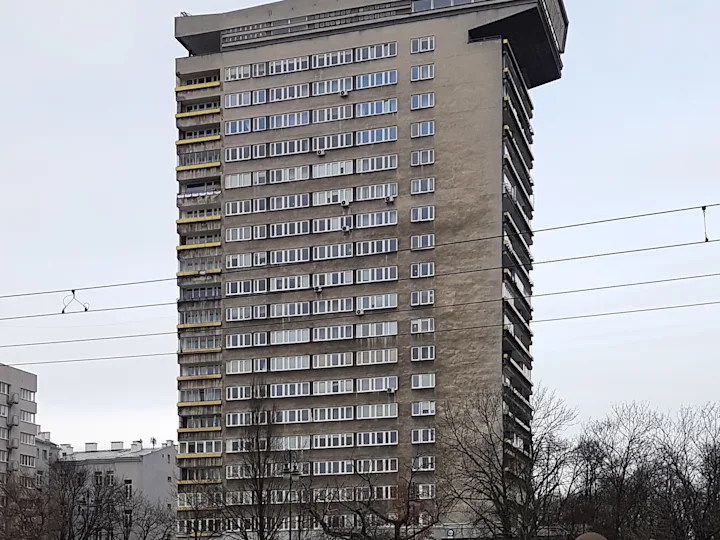
Smolna 8
The Vandelay collection
Begin in Warsaw with the compact Keret House, the University Library and modernist and brutalist churches. The collection also reaches Michniów, where memorial architecture offers a different kind of encounter.
8 buildings2 cities in this collection

Where to begin
The largest city collections are a useful starting point. Follow a guide to explore its buildings and architectural context.
Places to look closer
A selection from our Poland collection. Each card takes you to the corresponding city guide.
 Warsaw
 Minimalist
Jakub Szczęsny
Explore Warsaw guide Michniów
 Nizio Design International
Explore Michniów guide Warsaw
 Contemporary
Stefan Kuryłowicz
Explore Warsaw guide Warsaw
 Postmodernist · Green architecture
Marek Budzyński, Zbigniew Badowski
Explore Warsaw guideWarsaw Modernist · Functionalist · Brutalist
Jan Bogusławski, Bohdan Gniewiewski
Explore Warsaw guide Warsaw
 Modernist
Wojciech Kowalczyk, Andrzej Ustian
Explore Warsaw guide Warsaw
 Contemporary · Sacred
Wojciech Kuryłowicz, Andrzej Mikulski
Explore Warsaw guide Warsaw
 Brutalist · Sacred
Wojciech Siekiewicz, Marta Siekiewicz
Explore Warsaw guideFollow an interest
These styles are the most represented in our Poland collection. Choose a city to see local examples.
Look for Temple of Divine Providence in Warsaw and Church of Virgin Mary, Mother of the Church in Warsaw .
Look for Wolf Bracka in Warsaw and Temple of Divine Providence in Warsaw .
Look for Smolna 8 in Warsaw and Church of Virgin Mary, Mother of the Church in Warsaw .
The wider context
Poland's architectural landscape carries the weight of a turbulent 20th century — and the ambition of what followed. With 8 catalogued structures across 2 cities, the collection centres on Warsaw, a city that was almost entirely destroyed in 1944 and has been rebuilding its identity through architecture ever since. What makes Polish architecture distinctive is not volume but intensity: each building here tends to carry an outsized story.
From the world's narrowest house to sweeping sacred Brutalism, from Postmodern green rooftops to sombre memorial architecture, Poland's built environment oscillates between the monumental and the intimate. Warsaw dominates the catalogue with the vast majority of entries, but even a single building outside the capital — the Mausoleum in Michniów — demonstrates the country's capacity for architecturally powerful commemoration.
Polish architecture tells a story of erasure and reinvention. The buildings catalogued here span sacred Brutalism, ecological Postmodernism, and radical Contemporary insertions. Here is what to look for.
Poland's postwar churches are some of the most architecturally ambitious Sacred buildings in Europe. Constructed under political constraints, they became acts of cultural resistance. Wojciech Siekiewicz and Marta Siekiewicz's Church of Virgin Mary uses heavy concrete forms and narrow light openings to create interiors of austere contemplation. Look for:
Raw concrete exteriors with dramatic, fortress-like massing — churches as defiant monuments
Unexpected geometry: folded planes, asymmetric towers, and non-traditional floor plans
Interior light effects — narrow slits, coloured glass, and indirect light creating contemplative atmospheres
Warsaw's Contemporary architecture explores what can be inserted into a historically fractured city. Jakub Szczęsny's Keret House — at 92 cm wide the world's narrowest habitable building — is the most radical example. Marek Budzyński and Zbigniew Badowski's University of Warsaw Library demonstrates Green Architecture as public amenity, with a rooftop garden that has become one of the city's most popular public spaces. Key recognition points:
Extreme site responses — buildings squeezed into impossible gaps
Green Architecture as public amenity — roof gardens and living walls designed as accessible urban space
Historical layering in materials and forms — new buildings acknowledging the traces of what stood before
Poland's memorial buildings carry a particular gravity. Architecture here serves as witness. Nizio Design International's Mausoleum in Michniów abstracts landscape into a building form that merges with the earth. Watch for:
Abstracted landscape forms — buildings that merge with the earth or mimic geological erosion
Deliberate material roughness — unfinished surfaces conveying loss and endurance
Spatial sequences designed to create emotional progression — from open approach to enclosed contemplation
Polish architecture is defined by the tension between collective memory and forward momentum. Buildings here are rarely neutral — they commemorate, provoke, or stake claims on urban space. The catalogue may be compact, but the density of meaning per building is exceptional. This is architecture that demands context to fully appreciate, making it ideal for guided exploration on foot.
Take it with you
Find documented buildings on the map, explore their stories, and see nearby places with live distances in AR.