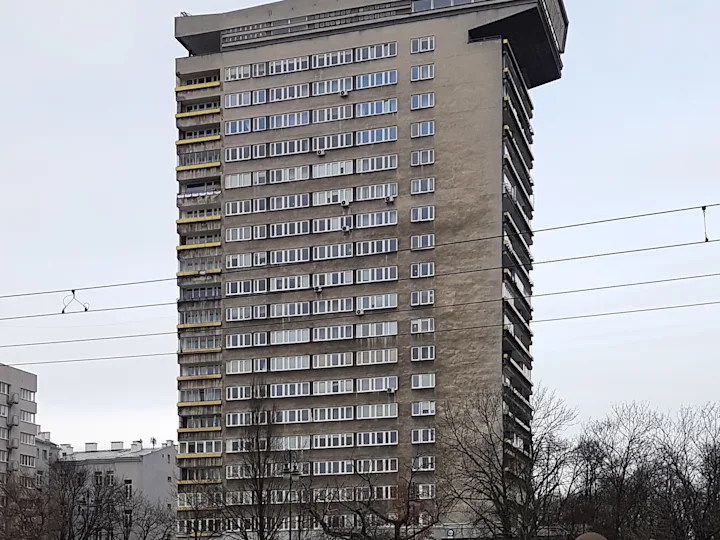
 Warsaw
 By Bohdan Gniewiewski, Jan Bogusławski
Explore Brutalist in WarsawThe Vandelay collection
Brutalist architecture takes its name from béton brut — raw concrete — and makes the material itself the building's primary expression.
55 buildings in this collection · 23 cities · 10 countries

Look closer
Brutalism is visually unmistakable. Here is what to look for.
Raw, exposed concrete (béton brut) is the defining material. The surface shows the imprint of timber formwork — board-marked textures with visible grain patterns. Concrete is left unpainted and unfinished. In London, the Barbican Estate's towers display the full vocabulary: board-marked concrete with a hammered aggregate finish that gives each surface a distinctive texture.
Massive, sculptural volumes with a sense of weight and permanence. Buildings often appear as monoliths — heavy blocks, cylinders, or stacked horizontal decks. Berlin's Mäusebunker stacks laboratory decks in a stepped pyramid of raw concrete. Goldfinger's Trellick Tower in London separates its service tower from the residential slab, connected by walkways at every third floor.
Repetitive structural bays create a strong visual rhythm. Deep window recesses cast dramatic shadows. The facade IS the structure — there is no cladding or veneer hiding the concrete frame. Surfaces are deliberately rough, not smooth. Look for the interplay of heavy concrete walls and deeply set voids.
Board-marked concrete — timber grain imprinted in the surface
Deep window recesses that cast strong shadows
Exposed structural elements — beams, columns, service ducts
Walkways and elevated platforms connecting building volumes
Repetitive modular bays — the same unit repeated across the facade
Monumental entrances — oversized openings cut into massive walls
Brutalist buildings make no attempt to blend in. They announce themselves through sheer material presence. In urban settings they often occupy large sites — housing estates, civic complexes, cultural centres — where the building IS the environment. The Barbican in London is the most complete example: a self-contained city within the city.
12 examples from our collection of 55 buildings. Follow a building’s city guide to explore more examples of this architecture.
Warsaw By Bohdan Gniewiewski, Jan Bogusławski
Explore Brutalist in Warsaw Lausanne
 By Atelier des Architectes Associés, Jean Prouvé
Explore Brutalist in Lausanne Berlin
 By Georg Heinrichs
Explore Brutalist in Berlin London
 By Ernő Goldfinger
Explore Brutalist in London Syracuse
 By Michel Andrault, Pierre Parat
Explore Brutalist in Syracuse Bensberg
 By Gottfried Böhm
Explore Brutalist in Bensberg Pantin
 By Jacques Kalisz
Explore Brutalist in Pantin Köln
Köln By Gottfried Böhm
Explore Brutalist in Köln Éveux
Éveux By Le Corbusier
Explore Brutalist in Éveux Sant Just Desvern
 By Ricardo Bofill
Explore Brutalist in Sant Just Desvern Paris
Paris By Martin Schulz van Treeck
Explore Brutalist in Paris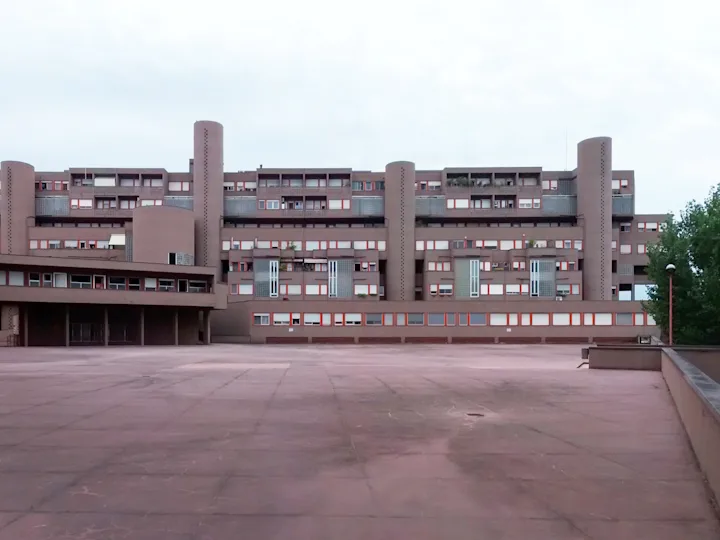 Milan
Milan By Aldo Rossi, Carlo Aymonino
Explore Brutalist in MilanThe wider context
Brutalist architecture takes its name from béton brut — raw concrete — and makes the material itself the building's primary expression. The catalogue holds 55 Brutalist buildings across 23 cities, the second most represented style.
The highest concentration is in Berlin (20 buildings), followed by London (8) and Paris (4). Brutalism emerged in the 1950s from the post-war reconstruction effort — social housing, civic buildings, universities — where the honest use of concrete was both an economic necessity and an ideological statement. These buildings were never meant to be pretty. They were meant to be truthful.
Today Brutalism is the most polarising architectural style: despised by some, fiercely defended by others, and increasingly listed for preservation. The buildings in this catalogue — from London's Barbican to Berlin's Mäusebunker — represent the full spectrum, from monumental civic projects to experimental sacred architecture.
Start with the cities with the most documented examples in this collection. Each count refers to buildings tagged Brutalist in Vandelay.
Germany Start with Apartment complex Pichelsdorf.
Explore Brutalist in BerlinEngland Start with Balfron Tower.
Explore Brutalist in LondonFrance Start with Les Orgues De Flandre.
Explore Brutalist in ParisCounts show their documented Brutalist buildings. The links open each architect’s wider collection.
Take it with you
Find documented buildings on the map, explore their stories and see nearby places with live distances in AR.